

Table of Contents
Professional Web Development for London, Ontario Businesses
Your website is often one of the most important digital assets supporting your business. It can introduce your company, explain your services, generate leads, sell products, provide customer resources, connect with other business systems, and support your broader marketing strategy. Choosing the right web developer means finding someone who understands how all of those pieces need to work together.
Innovative Global Vision provides professional website development for businesses throughout London and Southwestern Ontario from our office at 341 Talbot Street, Suite 319 in London, Ontario.
Our approach goes beyond building attractive pages. We consider website strategy, WordPress development, mobile usability, search visibility, conversion opportunities, performance, hosting, security, maintenance, integrations, and future growth.
A successful website should be designed for where your business is today while providing enough flexibility to support where you want it to go. New services, locations, integrations, landing pages, marketing campaigns, customer resources, or e-commerce functionality should not automatically require starting over with an entirely new website.
Learn more about our London website design and digital marketing services .
What Does a Website Developer Do?
A professional web developer takes the goals, designs, content, functionality, and technical requirements of a website and turns them into a working digital experience.
Some development work is visible to the customer, such as navigation, forms, interactive elements, responsive layouts, product filters, or account functionality. Other development happens behind the scenes and includes databases, integrations, APIs, content-management configuration, hosting, caching, user permissions, security controls, and other systems required to operate the website.
For a business owner, good website development should often feel invisible. The website simply works the way it is supposed to work. Pages load properly, forms deliver information, customers can navigate the site, mobile layouts function correctly, content can be updated, and important systems communicate with one another.
The technical decisions behind that experience matter. A website built without considering future maintenance, performance, integrations, security, or expansion may become difficult and expensive to manage later.
Common Website Development Responsibilities
Depending on the requirements of a project, website development can include:
- Website architecture and technical planning
- WordPress installation and configuration
- Custom page templates
- Responsive website development
- Contact and lead-generation forms
- Custom fields and structured content
- Website search and filtering
- Third-party integrations
- API connections
- E-commerce development
- User accounts and permissions
- Analytics and tracking implementation
- Performance optimization
- Website migrations
- Testing and troubleshooting
- Hosting configuration and website launch
Web Development Services for London Businesses
Different businesses require very different websites. A professional services firm may primarily need lead generation, while a manufacturer may need detailed product information, technical documents, representative locators, distributor resources, or custom forms. A retailer may need e-commerce, while an association may require member-only content or searchable directories.
That is why website development should begin with business requirements rather than technology. Technology should support the solution, not determine it.
IGV develops websites for a variety of business needs, including:
- Professional service websites
- Manufacturing websites
- Contractor and home-service websites
- Business-to-business websites
- E-commerce websites
- Membership and association websites
- Resource libraries
- Business directories
- Lead-generation websites
- Multi-location websites
- Landing pages and campaign websites
- Website redesigns and rebuilds
The best solution depends on your customers, business processes, content, marketing strategy, required functionality, and plans for future growth.
Web Development vs. Web Design
Web design and development are closely related, but they are not exactly the same discipline.
Website design focuses heavily on the visual experience: layout, typography, colours, imagery, branding, page hierarchy, navigation, calls to action, and how information is presented.
A web developer focuses more heavily on how the website is built and how its functionality works. Development may include templates, responsive behaviour, forms, integrations, databases, content-management configuration, custom functionality, performance, and other technical requirements.
The best projects connect the two disciplines. Design decisions should consider development, and development decisions should consider the user experience.
A visually impressive design can become difficult to maintain if it creates unnecessary technical complexity. Likewise, technically strong development can still result in a poor website if visitors cannot understand the information or easily find what they need.
At IGV, website design, development, content, SEO, and digital marketing can be considered together rather than being handed between unrelated providers.
Freelancer vs. Full-Service Web Development Agency
Businesses can choose from independent freelancers, boutique development firms, full-service agencies, internal development teams, and larger national providers.
There is no single model that is right for every project. A freelancer can be an excellent choice when the work is clearly defined and fits that person's expertise and availability. A full-service agency can become valuable when a website involves several disciplines or requires ongoing support after launch.
When comparing a freelancer, agency, or individual web developer, consider the complete life of the website rather than only the initial build.
| Project Scope | Can be well suited to smaller or specialized projects. | Can provide multiple disciplines for larger or more complex projects. |
| Available Expertise | Depends largely on one person's skills and external network. | May include developers, designers, marketers, content specialists, and support staff. |
| Availability | Dependent on an individual's workload and schedule. | Work and support can often be distributed across a broader team. |
| Ongoing Support | Varies significantly by provider. | May include structured hosting, maintenance, security, and technical support. |
| Digital Marketing | May require separate SEO, content, and marketing providers. | Can integrate website development with SEO, content, analytics, and marketing. |
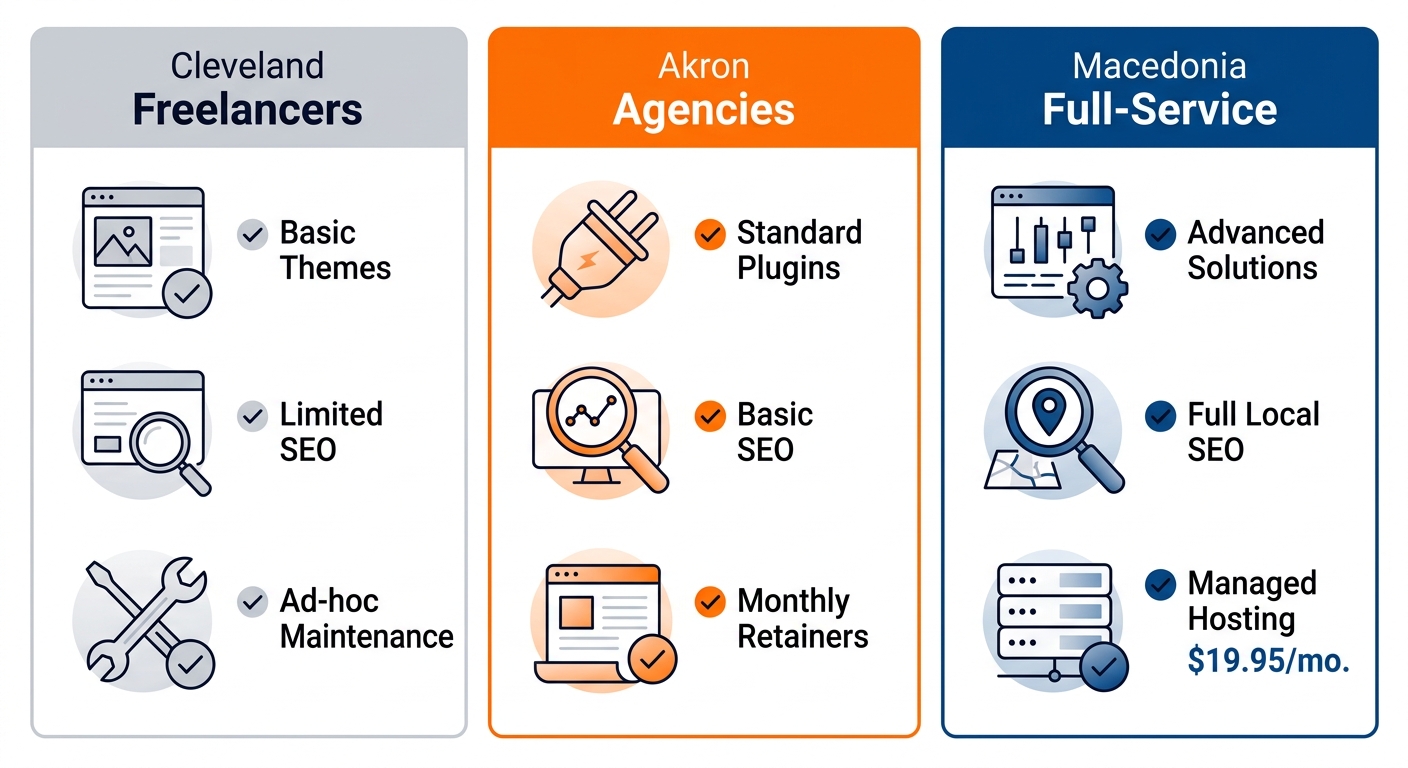
Freelancers and agencies can both be appropriate choices depending on project scope, expertise, support requirements, and long-term needs.
WordPress Website Development
WordPress provides a flexible content-management platform that can support a wide range of business websites.
Working with an experienced web developer can help businesses use WordPress as a scalable website platform rather than simply installing a theme and assembling a collection of plugins.
A well-developed WordPress website can support custom page layouts, structured content, landing pages, integrations, service areas, lead-generation tools, e-commerce, searchable resources, forms, analytics, and other functionality.
WordPress is also designed to allow authorized users to manage website content without requiring a developer every time a paragraph, image, employee, service, article, or other routine piece of information changes.
However, flexibility does not eliminate the need for good technical decisions. Themes, plugins, hosting, custom code, page builders, integrations, databases, and security practices can all affect how reliable and maintainable the website becomes.
Learn more about our WordPress website design and development services .
Custom Website Functionality & Integrations
Some websites need to do far more than publish pages. They may need to communicate with other systems, collect structured information, automate business processes, or provide specialized functionality for customers or employees.
Depending on the project, website integrations can connect with:
- Customer relationship management systems
- Email marketing platforms
- Scheduling and booking systems
- Payment processors
- Accounting software
- Inventory systems
- Mapping applications
- Membership systems
- Learning-management systems
- Analytics platforms
- Marketing automation tools
- Third-party APIs
The goal should not be to create custom functionality simply because it is possible. Custom development should solve a real business or customer problem.
For example, an integration may reduce duplicate data entry, allow website leads to flow into a CRM, display information from another system, automate appointment booking, or make a business process more convenient for customers.
Before developing custom functionality, it is important to understand how information needs to move, who will use the feature, what permissions are required, what happens when an external service is unavailable, and who will maintain the connection over time.
Website Redesigns & Migrations
Many London businesses looking for website development already have an existing website. The project may involve modernizing an outdated design, improving functionality, moving away from a restrictive platform, rebuilding an older WordPress site, or creating a better foundation for SEO and digital marketing.
A website redesign should begin with an evaluation of what already exists. The goal is not to throw away valuable content, search visibility, integrations, or functionality simply because the appearance of the website is changing.
A redesign review can include:
- Existing website content
- Current URLs
- Organic search traffic
- Important landing pages
- Existing backlinks
- Forms and lead-generation functionality
- Current integrations
- Plugins and custom functionality
- Analytics and tracking
- Hosting and domain configuration
When URLs change, redirects may be required so visitors and search engines are sent to the appropriate replacement pages.
Website migrations also need careful planning. Moving between hosts, domains, platforms, or major site structures can affect functionality, forms, email delivery, analytics, search visibility, and other systems if the process is not managed carefully.
Responsive & Mobile-Friendly Development
Your customers may visit your website from smartphones, tablets, laptops, and desktop computers. Responsive development allows layouts and functionality to adapt to different screen sizes.
A professional web developer should consider more than whether a desktop page technically fits on a phone. Navigation, forms, buttons, tables, images, interactive elements, calls to action, content hierarchy, and spacing all need to remain usable.
Mobile usability should be considered throughout development rather than treated as a final cleanup step.
This is especially important for businesses that rely on phone calls, appointment requests, quote forms, directions, product purchases, or other actions that customers may complete directly from a mobile device.
Responsive development also helps create a more consistent website-management experience because businesses do not need separate desktop and mobile websites.
E-Commerce & WooCommerce Development
E-commerce websites are operational business systems as well as marketing websites. They need to guide customers from product discovery through checkout while supporting payments, inventory, shipping, taxes, notifications, and other business requirements.
WooCommerce extends WordPress with e-commerce functionality and can support businesses ranging from relatively straightforward online stores to more customized applications.
Depending on the business, an online store may require:
- Product categories
- Search and filtering
- Product variations
- Inventory management
- Shipping calculations
- Payment processing
- Coupons and promotions
- Customer accounts
- Order notifications
- Tax configuration
- Accounting integrations
- Inventory or fulfilment integrations
The appropriate solution depends on the products being sold, the customer journey, payment requirements, fulfilment process, integrations, and how the business expects the store to grow.
SEO & Website Development Should Work Together
SEO should not begin only after a new website launches. Development decisions can influence how easily search engines understand, crawl, index, and navigate a website.
If you are hiring a web developer to redesign an existing site, protecting valuable search visibility should be part of the planning process.
Important considerations can include:
- Website architecture
- Page URLs
- Navigation
- Internal linking
- Page headings
- Content organization
- Mobile usability
- Website performance
- Image optimization
- Structured data where appropriate
- Redirects from old URLs
A redesign that ignores existing search performance can unintentionally remove pages or change URLs that were already bringing valuable traffic to the business.
IGV combines website development and SEO expertise within the same team, allowing us to consider search visibility while the website is being planned and developed.
For businesses targeting customers throughout London and Southwestern Ontario, our Local SEO services can further support geographic search visibility.
Website Performance, Accessibility & Usability
Website Performance
A website can look impressive and still provide a frustrating experience if it loads slowly, breaks on certain devices, or becomes unreliable.
Website performance can be affected by images, scripts, plugins, fonts, page-builder output, third-party applications, video, databases, caching, hosting, and tracking tools.
Good development tries to balance design, functionality, marketing requirements, and performance instead of treating performance as something to repair after the website has already been completed.
Website Accessibility
Accessibility is another important consideration when building a modern website.
The Web Content Accessibility Guidelines published by the World Wide Web Consortium provide internationally recognized recommendations for making digital content more accessible to people with disabilities.
Accessibility considerations can include logical heading structures, meaningful alternative text for images, keyboard navigation, sufficient colour contrast, understandable forms, visible focus states, readable content, and accessible links and controls.
Accessibility is not simply a plugin or an overlay. It involves decisions made throughout design, development, content creation, and ongoing website management.
Learn more about our website accessibility maintenance services .
Our Website Development Process
Good website development begins before anyone starts building pages. The first step is understanding what the business needs the website to accomplish.
Planning reduces expensive surprises later in a project. It gives the team an opportunity to identify content requirements, integrations, functionality, SEO considerations, technical requirements, and user journeys before those decisions become difficult to change.
A typical website project may include:
- Define business goals, audiences, functionality, and project requirements.
- Review the existing website and online presence when applicable.
- Plan website architecture, navigation, content requirements, and user journeys.
- Establish the visual and functional direction.
- Develop page templates, forms, functionality, and integrations.
- Add and format approved content.
- Test responsive layouts, forms, links, and major functionality.
- Review redirects and SEO considerations for redesigned websites.
- Prepare the production hosting environment.
- Launch the website and complete post-launch checks.
- Continue with hosting, maintenance, SEO, content, and marketing as needed.
Not every website follows exactly the same process. A small informational site has different requirements from a large e-commerce store, directory, membership website, or application with extensive integrations.
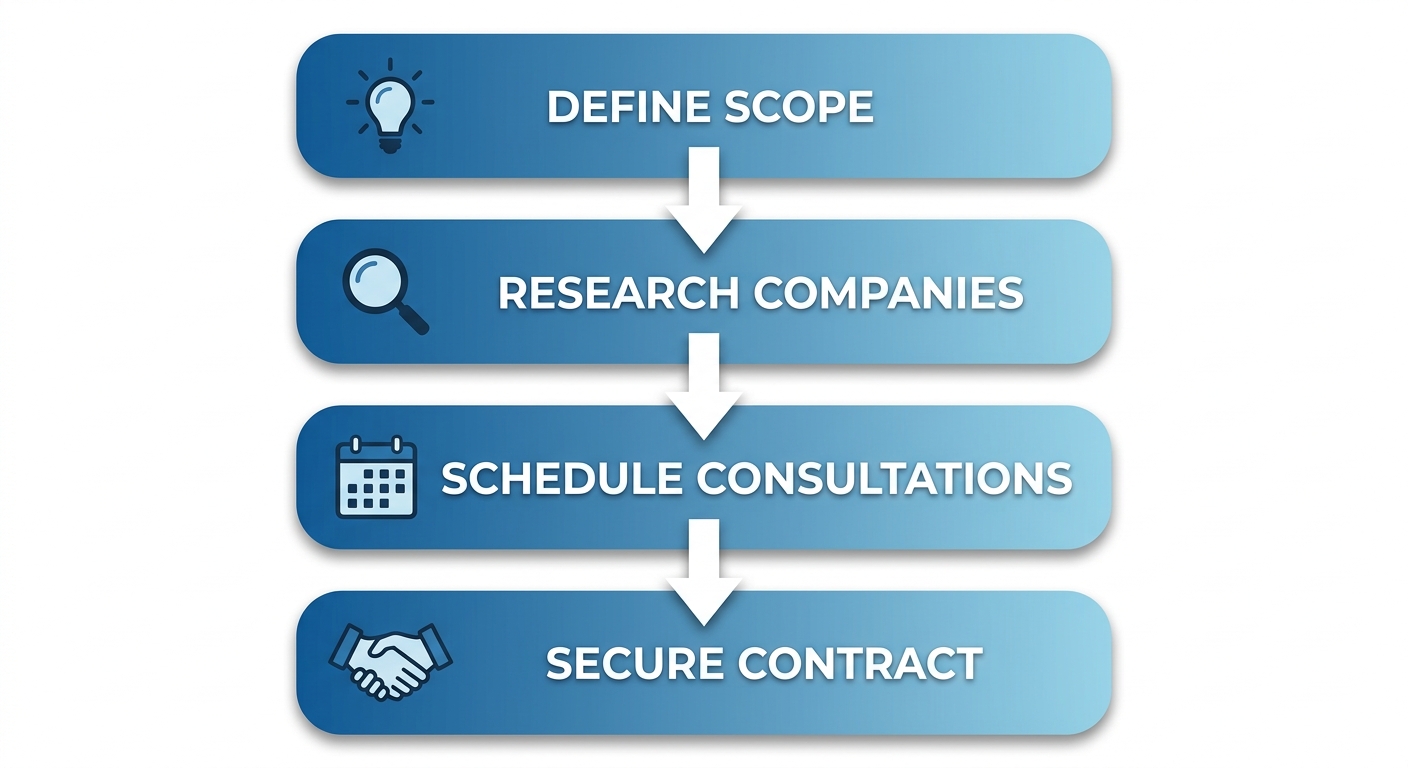
A structured website development process connects strategy, design, development, testing, launch, and ongoing support.
What Happens After Your Website Launches?
A website's launch should not mark the end of the relationship with the company that built it.
WordPress core software, themes, plugins, hosting environments, browsers, integrations, security threats, and business requirements continue to change.
Your business may also introduce new services, change staff, add locations, update products, publish content, run marketing campaigns, or identify opportunities to improve the website based on customer behaviour.
That is why ongoing support can be just as important as the original website project.
Post-launch website support can include:
- WordPress software updates
- Plugin and theme updates
- Website backups
- Security monitoring
- Performance monitoring
- Technical troubleshooting
- Content changes
- New landing pages
- Additional functionality
- SEO and content improvements
IGV provides managed WordPress maintenance and support for businesses that want an experienced team looking after their website after launch.
How to Choose the Right Website Development Partner
Choosing a web developer should involve more than comparing hourly rates or looking at screenshots of finished websites.
Your website may remain at the centre of your marketing for years, so it is important to understand how a prospective provider approaches planning, development, testing, hosting, maintenance, support, SEO, and future expansion.
Questions to Ask Before Hiring
- What types of websites do you regularly develop?
- Who will actually work on my project?
- How do you plan website architecture and navigation?
- How is mobile responsiveness handled?
- Do you consider SEO during development?
- How do you approach website accessibility?
- Can you develop custom functionality?
- Can you integrate third-party software?
- How are existing URLs handled during a redesign?
- What testing happens before launch?
- Who manages hosting?
- What happens after the site launches?
- Is ongoing maintenance available?
- Can the website be expanded later?
Red Flags to Watch For
Be cautious when a provider cannot clearly explain its development process, never discusses backups or ongoing maintenance, proposes replacing a ranking website without reviewing existing URLs, or promises outcomes that cannot reasonably be guaranteed.
You should also understand who controls your domain, hosting, website, content, analytics accounts, and other important digital assets.
Your business should not discover after launch that important accounts are controlled exclusively by a contractor or that moving the website to another provider is unnecessarily difficult.
A professional provider should also be able to explain technical decisions in language you can understand. You should know why a recommendation is being made and how it affects your website or business.
Why Choose Innovative Global Vision?
Website Development & Digital Marketing Under One Roof
IGV combines WordPress development, website design, hosting, maintenance, SEO, Local SEO, content, and digital marketing within one team.
That allows us to look at your website as part of a larger business and marketing system rather than treating development as an isolated technical project.
More Than a Website Build
Many businesses begin by looking for someone to build or repair a website, but what they eventually need is a dependable long-term digital partner.
If you are looking for a web developer, consider what happens after the initial project. IGV can continue supporting your website through hosting, maintenance, technical support, SEO, content creation, Local SEO, and broader digital marketing initiatives.
Local London Presence
IGV maintains a London, Ontario office serving businesses throughout London and Southwestern Ontario. This provides local organizations with access to a nearby team while also benefiting from IGV's broader website-development and digital-marketing capabilities.
WordPress Expertise
Our team works extensively with WordPress and understands that successful WordPress development involves more than constructing pages.
Hosting, plugins, integrations, backups, security, performance, future expansion, content management, and ongoing compatibility all need to be considered.
Designed for Long-Term Growth
We approach website projects with the expectation that the business will change. Products change. Services change. Employees change. Markets change. Technology changes.
Your website should have enough flexibility to change with your organization.
See Our Website Development Work
A provider's portfolio can help you evaluate the variety of websites it has developed and the types of organizations it has supported.
Explore our WordPress design portfolio to view examples of websites developed for businesses and organizations.
Frequently Asked Questions About Website Development
How is website development different from website design?
Website design focuses heavily on visual presentation, layout, branding, and user experience. Website development turns those requirements into a functioning site and handles the templates, content-management system, forms, integrations, databases, responsive behaviour, and other technical components.
Should I hire a freelancer or an agency?
Either can be appropriate. The decision should be based on project scope, required expertise, availability, ongoing support needs, and whether your business also needs services such as SEO, hosting, maintenance, content, or digital marketing.
Can an existing website be redesigned?
Yes. Existing websites can often be redesigned while preserving valuable content and functionality. The current site should first be reviewed for URLs, search traffic, integrations, forms, plugins, content, analytics, and functionality that needs to remain.
Can you move a website from another provider?
In many cases, yes. The migration process depends on the existing platform, hosting environment, ownership of website files and databases, domain configuration, email, integrations, and other technical requirements.
Can WordPress support custom functionality?
Yes. WordPress can support custom content structures, forms, directories, integrations, e-commerce, user functionality, APIs, and other specialized features depending on the requirements of the project.
Can a website connect to our CRM?
Many websites can be connected to CRM platforms through direct integrations, APIs, automation tools, or form integrations. The appropriate method depends on the CRM, the information being transferred, and the workflow the business needs.
Does website development include SEO?
Website development should consider search-friendly structure and technical fundamentals. Ongoing SEO, however, involves additional work such as research, content creation, optimization, Local SEO, monitoring, and continued improvement.
Who maintains the website after launch?
That depends on the agreement with your development provider. IGV offers managed WordPress maintenance and hosting so businesses can continue receiving software updates, monitoring, backups, security oversight, and technical support.
Can our team update the website?
WordPress allows authorized users to manage website content. The exact editing experience depends on how the website is constructed and which areas the business needs to maintain internally.
How long does website development take?
There is no universal timeline. Project length depends on the size of the website, required functionality, integrations, design requirements, content availability, feedback, approvals, testing, and how quickly project decisions can be made.
How much does a website cost?
Website development costs depend heavily on scope. A relatively straightforward informational website requires fewer development resources than an e-commerce site, searchable directory, membership website, custom application, or website with multiple integrations.
A useful website proposal should explain what is included, what functionality will be developed, what the client's responsibilities are, and what services continue after launch rather than providing only an unexplained project price.
Start Your London Website Development Project
Your website should support more than today's immediate requirements. The right technical foundation can make it easier to introduce new services, expand into additional markets, improve search visibility, connect other business systems, publish content, and adapt your digital marketing as your organization grows.
If you are looking for a web developer in London, Innovative Global Vision can help evaluate your existing website, project requirements, functionality, marketing goals, and long-term support needs.
Our London team provides professional website development supported by WordPress expertise, hosting, maintenance, SEO, Local SEO, content marketing, and broader digital marketing capabilities.
Contact Innovative Global Vision to discuss your website project and determine the right development approach for your business.
Resources